
How Rwanda’s Digital Civil Registration Reform is Transforming Health Policies and Outcomes
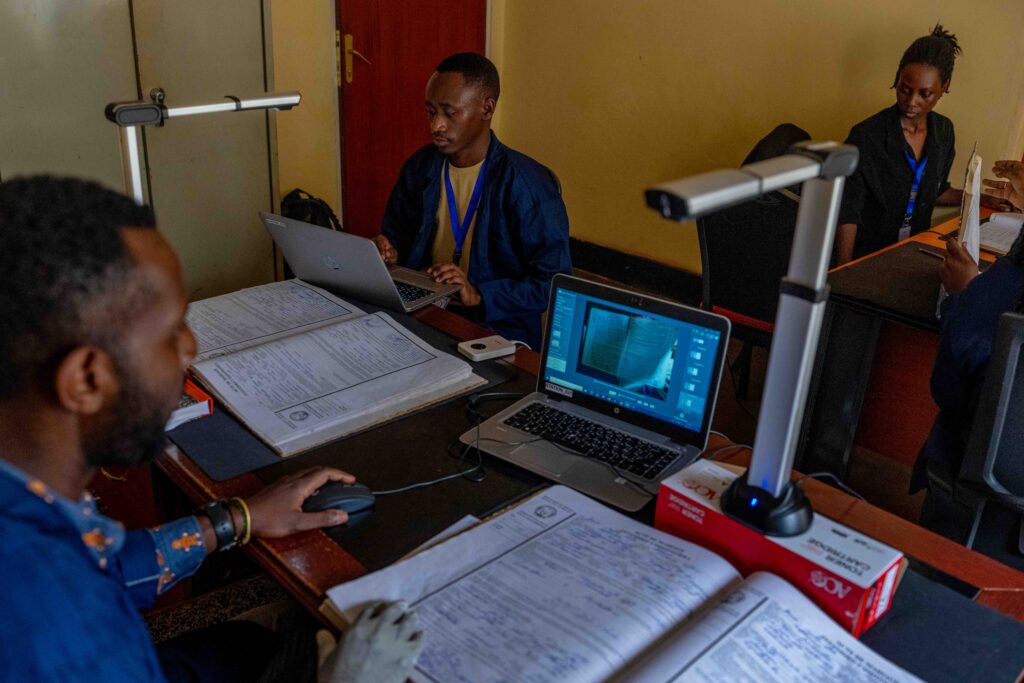
Rwanda has undertaken one of the most ambitious civil registration reforms in Africa: moving the entire system online. Every birth and death, and every identity (ID) document, is being digitized, including historical records dating back to the 1950s.
By ensuring that deaths are registered with an accurate cause of death, Rwanda is collecting essential data to understand population health, track disease patterns and guide policy decisions. The streamlined digital ID system links life events to personal records, improving access healthcare and other services. Backed by funding from the World Bank and the Bloomberg Philanthropies Data for Health Initiative, this effort reflects a national vision: to ensure that every Rwandan is counted, recognized and supported through timely and reliable data.
The process begins at birth. Mothers are assisted to register their newborns before leaving the hospital, and at the same time, the child receives their first vaccinations. Registration and health data are immediately linked to a unique national identification number. Emmanuel Mbarushimana, head of Muhoza Health Center, explained, “After registering the child, the child immediately has the right to be vaccinated and followed [through] an electronic database used for vaccination.” In this way, identity and health are inseparable; a child is both registered and enrolled in a care system from day one. Everything is done at once without placing any burden on the family.
Throughout the life course, digital registration and national identification automatically link people to over 200 services they may require or wish to access.
The process continues at death. Families are guided to register the passing of their loved one at the health facility or cell office, with details linked instantly to the national digital ID. The cause of death is recorded by staff and entered electronically, making sure vital health data is captured in real time. All of this happens in one step and supports families without adding any burden to their loss.
This digital integration is designed not only for the present but for the future. Rwanda is digitizing millions of past records to build a complete national archive. It is a corrective to history, where so many files, especially death records from the genocide, were lost. With a modern CRVS system, no birth or death will go unrecorded.
Beyond data collection, Rwanda is investing in the human capacity to transform data into policy and impact. Workshops and mentorships equip officials with the tools to clean, analyze and present information in ways that decision-makers can act on. “In those workshops, participants were trained on how to analyze their own data,” explained Theogene Kubahoniyesu, a data analyst at the Rwanda Biomedical Centre. For Lydia Businge, Data Officer at the Rwanda National Cancer Registry, these skills have been transformative. “I was able to use the skills we got from the workshop in developing a report on the trends of cancer in Rwanda. Policymakers, once they see those trends, can make decisions on what to prioritize and where to put more effort, especially in cancer control programs.”
The power of this new system is evident in Rwanda’s response to cancer. Rwanda faces an annual cervical cancer incidence of 28.2 per 100,000 women, with over 1,200 new cases and 800 deaths annually. Yet screening coverage remains just 18%, far short of the World Health Organization’s 70% target1.
The Ministry of Health used evidence from the CRVS and cancer registry data showing that more than 70% of cervical cancer deaths in Rwanda occurred in women diagnosed at an advanced stage, lowering chances of survival. These findings, published by the National Cancer Registry and cited in the National Cancer Control Plan, made clear that late detection was directly responsible for high mortality. This evidence led the Ministry to expand screening programs, mobilize volunteers to reach women in rural areas and invest in treatment centers. At a hospital in a remote region, women now arrive, present their ID, and can immediately access cancer screenings. The continuous tracking of deaths and their causes will permit government to see the impact of better screening and earlier detection services on cervical cancer deaths over time.
The story of Rwanda’s digital CRVS reform is so much more than a technical upgrade. It is a national commitment to everyone to provide a secure a trusted identity, improve health, and prepare for the challenges of tomorrow. From digitizing records lost to history, to expanding cancer screenings in the remotest areas, Rwanda is proving how death data – when complete, accessible, and actionable – can guide a nation’s path to save lives through better health.
[1] Gahongayire et al., Rwanda Public Health Bulletin, 2023
https://rbc.gov.rw/publichealthbulletin/img/rphb_issues/8957aad8477bb09633378e0ee89cad641712240376.pdf